
Published
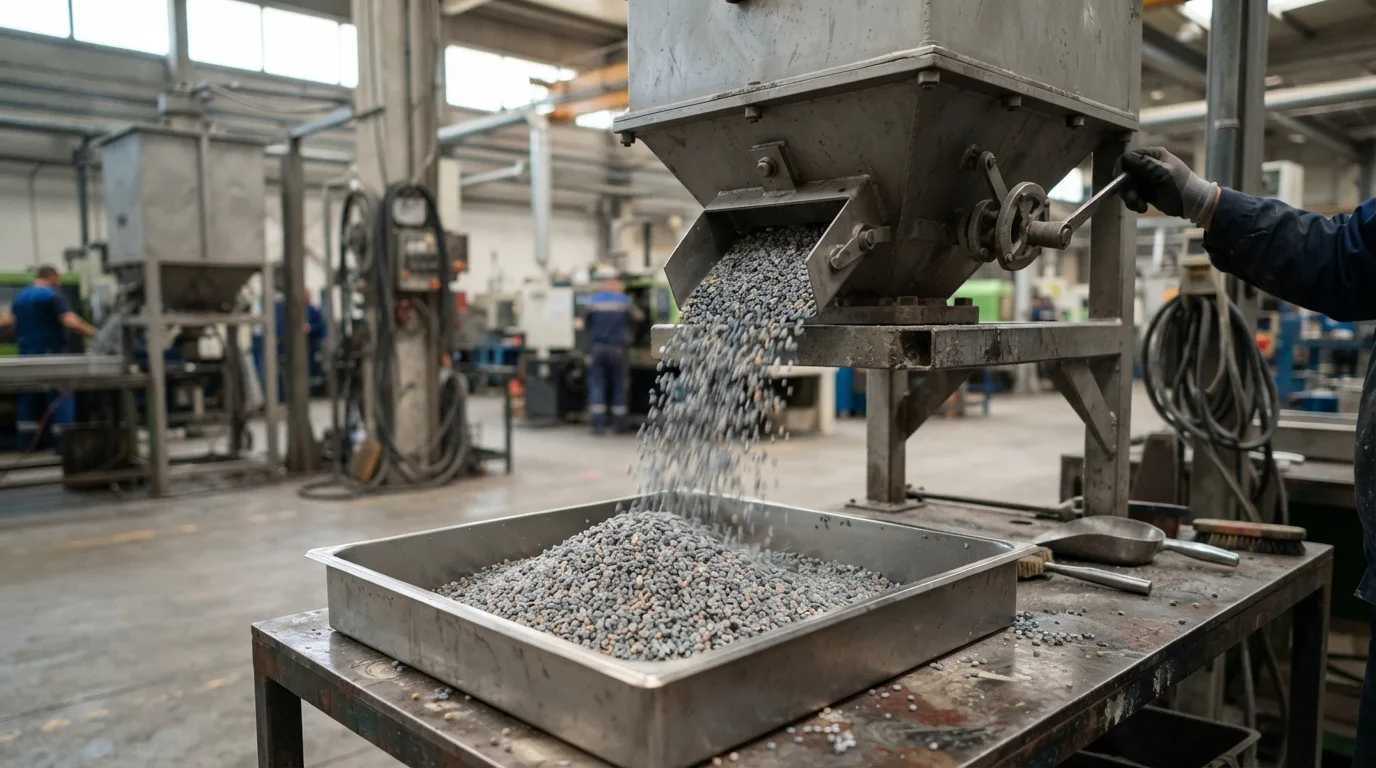 Clean grey and natural recycled pp granules pouring from an industrial hopper into an inspection tray on a factory floor
Processing plants rely on pp granules as the standardized pelletized form of polypropylene thermoplastic for moulding and extrusion lines. Compounded from virgin polymer or reclaimed scrap, these pellets provide balanced melt flow, stiffness, and heat resistance. Selecting the right grade ensures smooth cavity filling and stable tape drawing without line breaks.
What Does PP Stand for in Plastics and How Does Polypropylene Differ from Propylene?
PP stands for polypropylene, a semicrystalline addition thermoplastic derived from the catalytic polymerization of propylene monomer gas (C3H6). Monomeric propylene exists as a volatile, flammable gas under ambient room conditions. Through transition-metal catalysis, individual gas molecules link into long molecular chains, undergoing a physical state transition into a rigid, highly crystalline solid pellet known for high flexural fatigue resistance.
Unfilled polymer chains show a benchmark mass density of 0.90 to 0.91 g/cm³. This makes the polymer one of the lightest commercial engineering thermoplastics on the shop floor. Its crystalline melting peak falls between 160°C and 166°C, which permits high service temperatures without structural softening.
The saturated aliphatic polyolefin structure provides exceptional resistance to aqueous chemical solvents, mineral acids, and polar cleaning reagents. It resists environmental stress cracking when exposed to surfactants, though aromatic solvents cause swelling at elevated melt temperatures. When sourcing these materials for operations requiring compliance for food packaging, plant managers must confirm regulatory approvals directly with the supplier. For technical specification sheets or specific line inquiries, converters can consult Golden Square Plast.
How PP Reprocessed Granules Are Compounded from Industrial Scrap?
To compound pp reprocessed granules from industrial scrap, plants melt-blend sorted scrap streams through continuous twin-screw extrusion, vacuum degassing, and strand cutting. The feedstock sorting stage eliminates cross-contamination from high-density polyethylene or foreign dirt. Factory staff separate clean post-industrial offcuts, woven fabric strapping, and thermoforming edge trims into single-polymer streams. Contamination from polyethylene ruins final tensile strength by creating phase separation within the polypropylene matrix.
```
Feedstock Sorting & Shredding (Clean PP Scrap)
│
▼
Extrusion Plastification (190°C to 230°C with Degassing)
│
▼
Hydraulic Melt Filtration (80 to 120 Mesh Screen)
│
▼
Strand Water Cooling & Rotary Pelletization (3 mm to 4 mm)
```
Plastification takes place inside co-rotating twin-screw extruders or high-length-to-diameter single-screw systems. Barrel heaters operate across a graduated profile from 190°C in the feed throat to 230°C at the metering zone. Dual-port vacuum degassing wells pull away entrapped air, moisture, and degraded volatile oligomers before the melt enters the gear pump.
Continuous melt filtration removes unmelted fragments, oxidized gel specks, and airborne particulate. Hydraulic screen changers run woven wire mesh cloth between 80 mesh and 120 mesh. The filtered melt exits through a multi-hole strand die into a cooling water bath, where high-speed rotary pelletizers cut the chilled polymer strands into uniform cylindrical pellets measuring 3 mm to 4 mm in diameter. Alternatively, hot die-face cutters chop the melt at the die plate, sending the granules through water rings for circular pellet geometry.
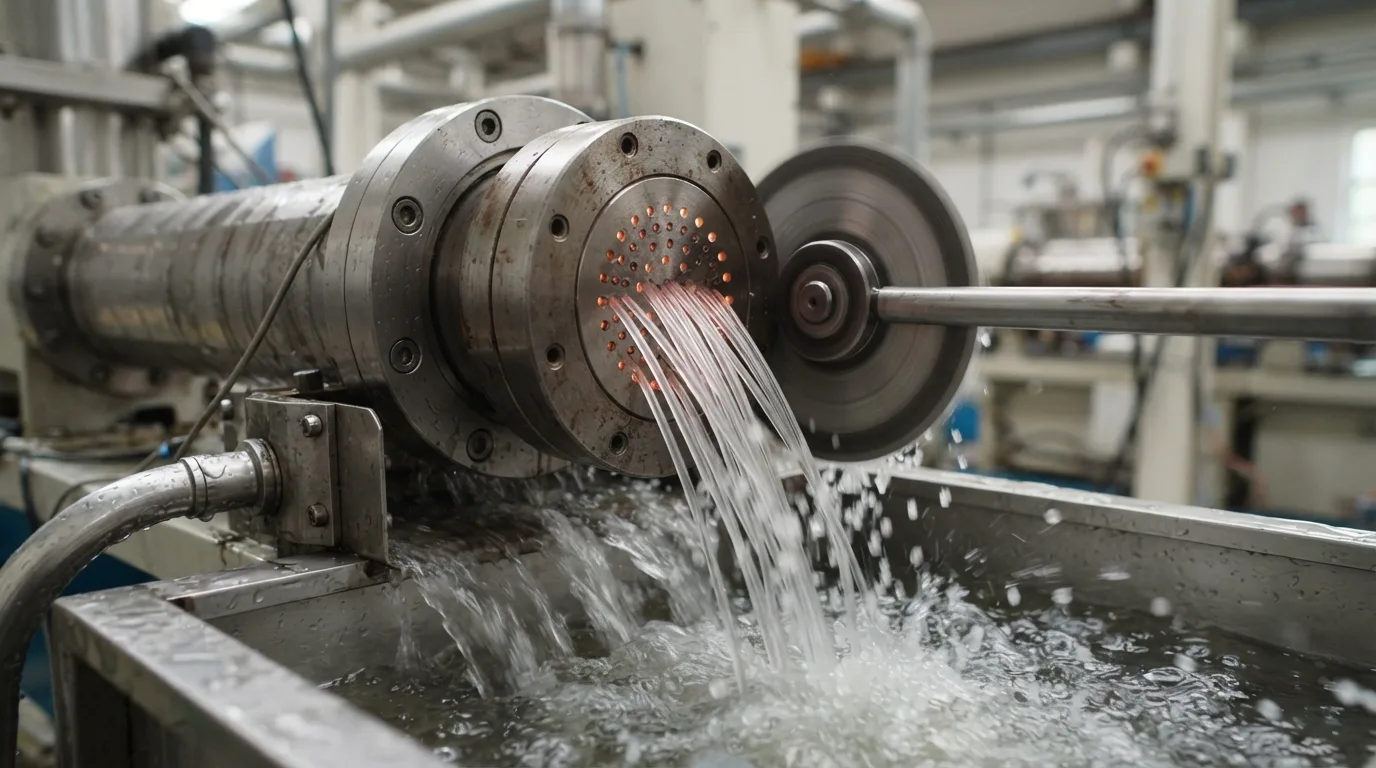 A twin-screw extruder compounding melted polypropylene granules through a multi-hole strand die
PP Raffia vs Injection Grades: How Melt Flow Index Dictates Line Compatibility
Melt Flow Index (MFI) measures how many grams of polymer flow through a standard capillary die over ten minutes at 230°C under a 2.16 kg test load. This rheological value reflects average molecular weight: high-molecular-weight polymers resist flow and yield low MFI values, whereas shorter molecular chains flow freely and register high MFI numbers.
The baseline for pp raffia requires a low MFI between 2.5 and 4.5 g/10 min. This low melt flow guarantees high melt strength inside the chill-roll casting unit. High melt strength prevents web sagging while extruding flat sheets before water-quench slitting. During subsequent hot-plate stretching, the long, entangled polymer chains orient along the draw axis, generating the high tensile orientation needed for woven FIBC bulk sacks and strapping without longitudinal fibrillation or split filaments.
Polypropylene injection molding demands a medium to high MFI, spanning 10 to beyond 25 g/10 min. Low melt viscosity lets the molten plastic rush through runner systems and fill thin-walled mold cavities under moderate hydraulic pressure. Rapid mold filling prevents premature gate freeze, minimizes molded-in warpage stresses, and shortens cycle times.
Technical Comparison: PP Raffia vs PP Injection vs PP Blow/Extrusion Granules
| Property Parameter | PP Raffia Grade | PP Injection Grade | PP Blow / Extrusion Grade |
|---|---|---|---|
| MFI @ 230°C / 2.16 kg (g/10 min) | 2.5 to 4.5 | 10.0 to 28.0 | 1.0 to 2.2 |
| Tensile Strength at Yield (MPa) | 32 to 38 | 26 to 34 | 28 to 35 |
| Elongation at Break (Absolute Ratio) | 1.5 to 3.0 | 0.5 to 1.8 | 3.5 to 6.0 |
| Processing Temperature Range (°C) | 215 to 245 | 195 to 230 | 185 to 215 |
| Conversion Line Suitability | Slit-film tape plants, circular looms, rope twisting | Multi-cavity molds, crates, thin-wall pails, closures | Extrusion blow moulding, sheet, corrugated profiles |
Cross-grade contamination on the shop floor causes immediate processing failure. Feeding low-MFI raffia into a high-cavity thin-wall mold yields short shots, scorched burn marks from air entrapment, and excessive hydraulic pressures that cause clamping-unit alarms. Conversely, processing an injection grade on a raffia tape line causes total bubble collapse, severe web sagging, and continuous filament breakage across the draw oven.
Converters balancing diverse manufacturing operations can view line-specific compounds across our Products catalogue.
Additives and Reinforcements in Reprocessed Polypropylene Granules
Secondary compounding alters polypropylene granules to meet strict structural and processing targets. Natural calcite mineral reinforces the resin matrix. Compounding facilities blend fine micro-calcite at five to twenty-five parts per hundred by weight. Calcite increases flexural modulus, accelerates internal mold cooling, suppresses sink marks, and reduces raw material volume consumption. Excessive mineral loading beyond thirty parts per hundred reduces weld-line elongation and makes finished mouldings brittle upon impact.
Heat and shearing during processing induce polymer chain scission. Extruders add primary sterically hindered phenolic antioxidants paired with secondary organophosphite stabilizers. These thermal stabilizers scavenge alkyl and peroxy free radicals during melt extrusion, preserving the base MFI across repeated heat cycles. Outside weather exposure degrades polyolefin backbones via ultraviolet photo-oxidation; compounding hindered amine light stabilizers (HALS) traps free radicals generated by sunlight, stopping surface chalking and tensile degradation.
Polypropylene exhibits notch sensitivity in freezing storage conditions. To increase low-temperature drop-impact performance, compounders blend elastomeric olefin modifiers like ethylene propylene diene monomer (EPDM) or polyolefin elastomers (POE) at five to fifteen parts per hundred. These elastomeric domains disperse within the polypropylene matrix, absorbing shock energy and arresting micro-crack growth during cold impacts.
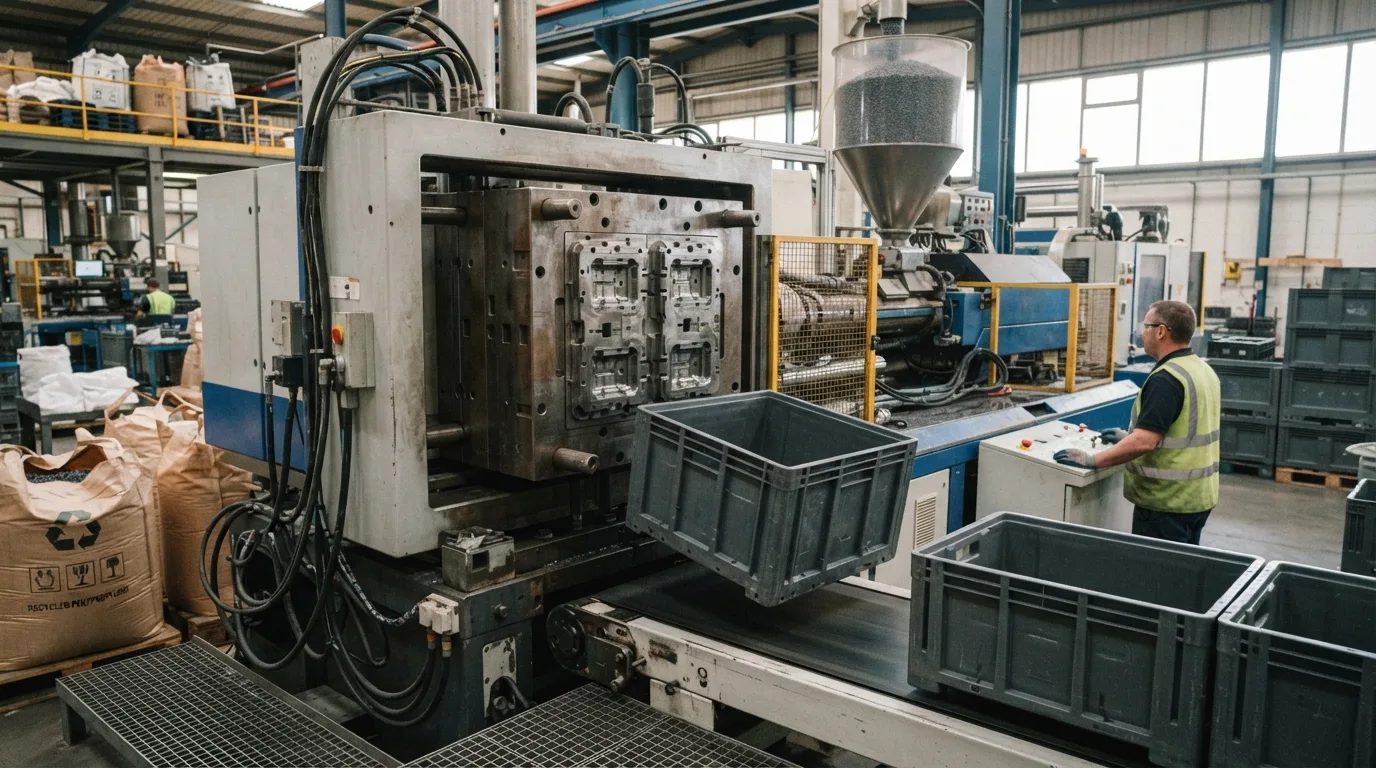 Industrial storage crates made with recycled polypropylene granules stacked neatly in a logistics warehouse
What Governs the Sourcing Valuation of pp granules per Kilogram?
The procurement cost per kilogram of polypropylene granules depends on resin purity, melt stability, pigment grade, and virgin polymer market indexes. Color categorisation sets the primary commercial baseline. Transparent and natural unpigmented lots command the highest premium because masterbatch color technicians can tint them into any custom shade. Milky white compounds rank next, followed by silver-grey, while mixed dark and black resins sit at lower cost tiers because they only suit dark-colored industrial goods.
Feedstock integrity forms the second commercial pillar. Granules compounded from a verified single-origin post-industrial source maintain consistent melt behavior and mechanical properties from pallet to pallet. Multi-source post-consumer lots or unwashed factory regrind often carry foreign polymers, degrading processing repeatability and lowering final resin value.
A strict MFI variance of within plus or minus 1.0 g/10 min commands higher valuation than wide-spec lots that fluctuate widely between bags. Total residual ash content also governs cost: unfilled, clean resins running mineral ash levels below fifteen grams per kilogram deliver predictable density, while heavily loaded compounds trade at lower unit costs to reflect their higher mineral mass.
Factory buyers can source consistent recycled grades from Golden Square Plast. Review technical specifications with our engineering team and Request a quote for your production schedule.