

Sustainability
Closing the Loop.
Circularity becomes real at the point where a factory can actually run recycled material. Everything here is about making that possible, rather than describing it.
The circular economy
One material, more than one life.
A linear supply chain takes a polymer, makes a product and discards it. A circular one returns the material to production. The difference is not philosophical — it is whether a manufacturer can buy a recycled grade that performs well enough to specify.
That is where a recycler either adds value or does not. Our part of the loop is the middle: taking mixed waste and returning it as a material a factory can plan around.
- 01
Plastic waste
Post-industrial offcuts and post-consumer packaging reach the end of their first life as material, not as rubbish.
- 02
Recycled raw material
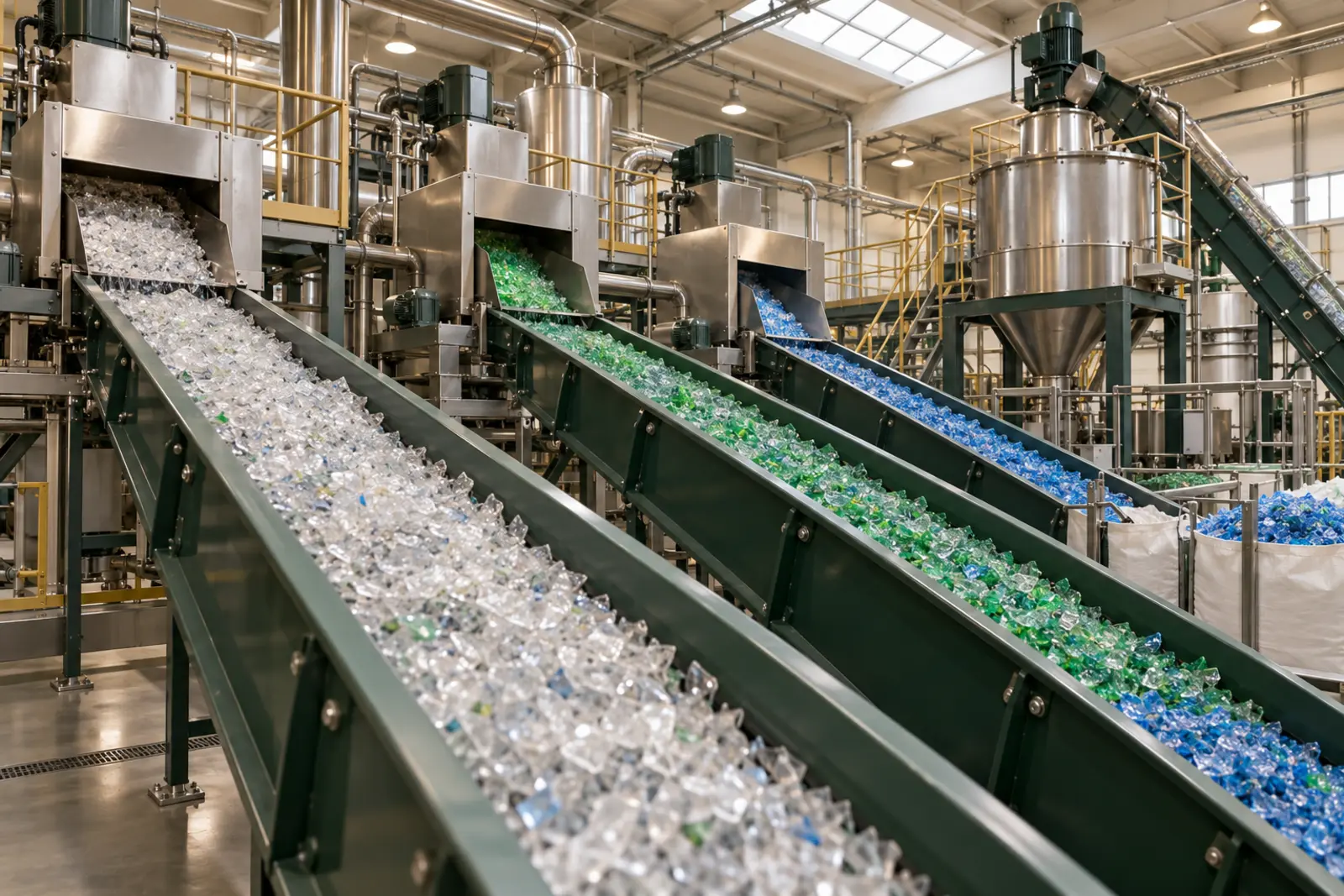
Sorting, washing and granulation convert that waste into a graded feedstock with predictable processing behaviour.
- 03
Manufacturing
The granules are moulded, extruded or blown on the same machines that run virgin polymer.
- 04
New product
Crates, containers, pallets, film and furniture enter service, made from material that had already been discarded once.
- 05
Extended material lifecycle
At the end of that life the polymer can return to the same loop. Each cycle is another life the material did not need replacing for.
From Waste to Value
The nine stages that make recycled material usable.
Each stage removes variability. The output is a graded feedstock rather than reclaimed plastic.
- 01
Plastic Waste
Post-industrial and post-consumer plastic arrives for intake.
- 02
Sorting
Material is separated by polymer type and stream.
- 03
Processing
Sorted material is size-reduced and prepared.
- 04
Cleaning
Contaminants are washed out of the material stream.
- 05
Recycling
Clean material is melted and homogenised.
- 06
Granulation
Melt is pelletised into uniform granules.
- 07
Quality Control
Batches are inspected before release.
- 08
Recycled Granules
Finished granules are packed for despatch.
- 09
New Industrial Products
Customers mould, blow and extrude new products.
What we do not claim
No figures we cannot evidence.
Environmental claims are easy to publish and hard to substantiate. We have chosen not to state CO₂ reductions, energy savings, diversion tonnages or certifications, because Golden Square Plast has not yet produced verified data for any of them.
When measured figures and third-party verification exist, they will be published here with their source and their scope. Until then, the honest statement is the simple one: material that would have been discarded is being returned to manufacturing as a usable industrial input.
Buyers with their own reporting obligations are welcome to ask what documentation we can provide for a specific grade and shipment. We would rather answer narrowly and accurately than publish a number that cannot be defended.
Request a Quote
Tell us what you manufacture.
Send the grade, colour and volume you need. We will come back with what we can supply against your process — and say so plainly where we cannot.