
Published
 Technical inspection of hdpe granules in a plant laboratory
High-density resin pellets provide converters with rigid mechanical strength and impact resistance. Producing uniform hdpe granules demands strict segregation of scrap feeds and molecular weight stabilization to match blow moulding or injection tooling parameters without causing line instability. Selecting between fractional blow grades and high-flow injection grades requires managing melt flow index, wall thickness uniformity, and environmental stress cracking.
What Are hdpe granules and What Is the Full Polymer Form?
The full form of HDPE is High-Density Polyethylene, and the pellets are semi-crystalline thermoplastic resin beads supplied for industrial conversion lines. The polymer structure features a linear, unbranched aliphatic chain backbone produced through catalytic addition polymerisation of ethylene monomer units. This linear molecular architecture differs from the extensive short-chain and long-chain branching present in ldpe granules.
The absence of bulky side chains allows the molecular backbones to pack closely together into an organized lattice. This high packing efficiency yields a typical base density range between 0.941 and 0.965 g/cm³. Within this density band, the polymer exhibits a crystalline fraction between 0.60 and 0.80. This dense crystalline matrix provides high tensile yield strength, rigid flexural modulus, and broad chemical resistance against aggressive acids, alkalis, and organic solvents. The remaining amorphous regions supply impact strength down to low operational temperatures. When converters require confirmation of safe handling protocols for plant workers, thermal degradation risks such as volatile fumes, mechanical dust, or fire hazards during processing form the focus of operational plant reviews. Packaging intended for use with food needs an approved grade, to be asked of our team at Golden Square Plast.
How Feedstock Selection Dictates Molecular Weight in Polyethylene Reprocessing
Polyethylene pellets are made by sorting industrial scrap into uniform polymer classes, shredding the articles, and extruding the washed flakes under controlled melt filtration. Scrap feedstock selection directly determines the average molecular weight and the molecular weight distribution of the reprocessed pellet. High-molecular-weight hollow articles, such as blow-moulded drums, chemical containers, and post-use jerrycans, consist of elongated polymer chains. Low-molecular-weight injection goods, such as bottle caps, industrial crates, and thin-wall baskets, contain shorter polymer chains designed for rapid cavity movement. Reprocessors maintain structural integrity by strictly isolating these scrap streams prior to mechanical granulating. Mixing hollowware scrap with injection crate scrap broadens the molecular weight distribution uncontrollably, triggering severe flow instability and wall thinning during subsequent conversion.
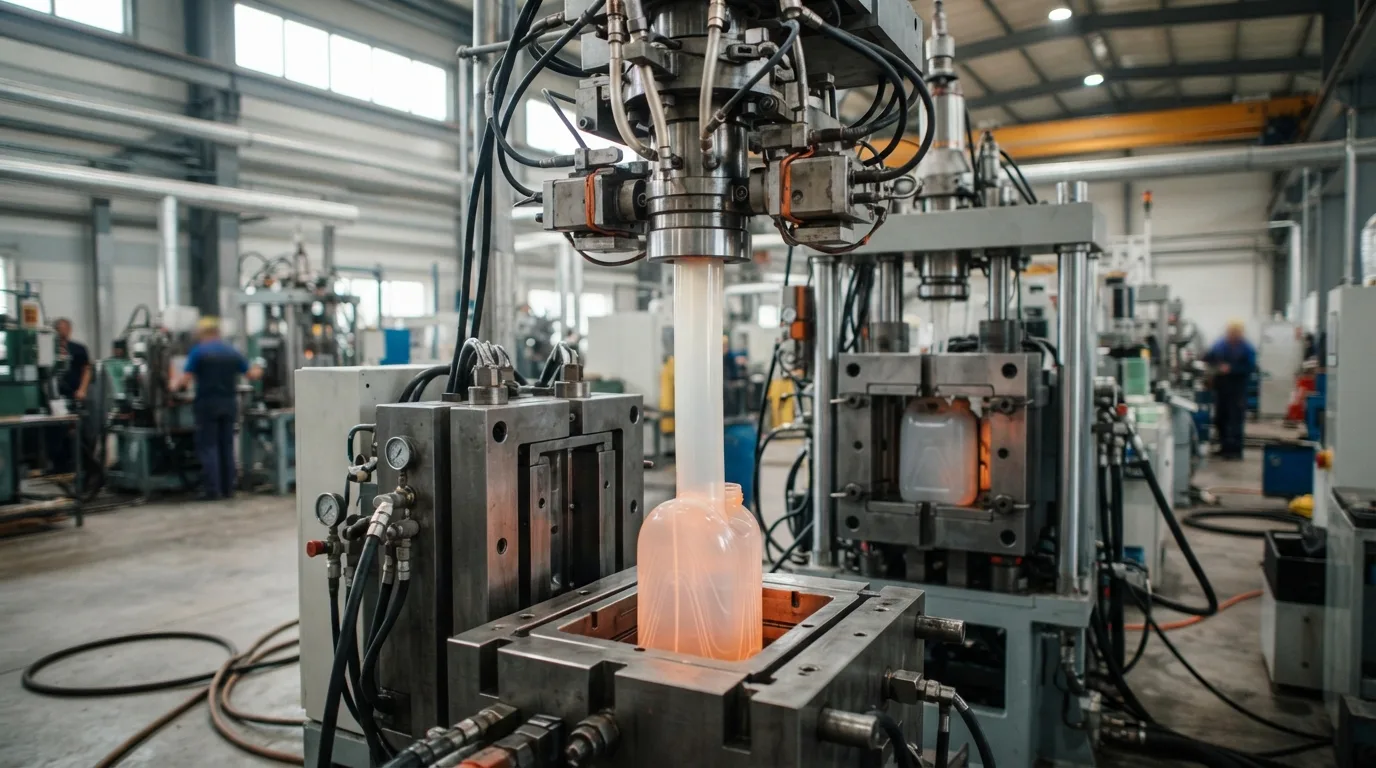 Continuous blow moulding line extruding a hollow parison for industrial jerrycan packaging
Secondary antioxidant and processing stabilizer packages protect long polymer backbones from chain scission and crosslinking during compounding. Stabilizer dosing runs between one and three parts per thousand of combined phosphite and hindered phenol blends. Phosphite additives react with melt-phase hydroperoxides to shut down thermal-oxidative degradation loops, while hindered phenols intercept free radicals generated inside the extruder barrel. Extrusion laboratories confirm molecular weight retention by pairing standard melt flow rate testing at 190°C under a 2.16 kg load with high-load melt index testing under a 21.6 kg load. The resulting flow rate ratio serves as a direct indicator of shear sensitivity and polymer chain length retention across consecutive heat histories.
Commercial HDPE Grades: Blow Moulding vs Injection Moulding
Commercial converters select specialized hdpe granules formulated for either hollow container extrusion or high-pressure cavity tooling across packaging lines. Converting plants encounter operational failures when an incorrect rheological grade enters the machine feed throat. Extrusion blow moulding machinery requires a fractional melt flow index between 0.2 and 1.1 g/10 min measured at 190°C under 2.16 kg. Long polymer chains generate high melt viscosity and elastic recovery, preventing the extruded vertical parison from sagging, necking, or tearing before the mould halves clamp shut.
Injection moulding presses demand high-flow grades with a melt index between 4.0 and 20.0 g/10 min at 190°C under 2.16 kg. Short polymer chains reduce melt viscosity, allowing the resin to travel through multi-drop hot runner nozzles and fill thin-wall part cavities swiftly under injection pressures between 80 and 140 bar. Using an injection grade on a blow moulding line causes immediate parison collapse, while running a fractional blow grade on an injection press creates short shots, intense core-pin deflection, and excessive cycle cooling times.
Chemical packaging operations also monitor Environmental Stress Crack Resistance (ESCR). Blow moulding grades formulated for active chemical packaging must withstand surfactant-induced chain slippage under mechanical stress. ESCR performance is validated through bent-strip testing under accelerated conditions in a ten-part-per-hundred surfactant reagent bath at 50°C. Fractional blow grades resist crack initiation under extended exposure, whereas high-flow injection grades show early failure under continuous hoop stresses.
| Polymer Grade | Target MFI (g/10 min at 190°C/2.16 kg) | Base Density (g/cm³) | Parison and Flow Behavior | ESCR Performance | Typical End Products |
|---|---|---|---|---|---|
| Blow Moulding Grade | 0.2 to 1.1 | 0.945 to 0.956 | High melt strength, controlled parison sag | Maintains integrity under prolonged surfactant exposure without cracking | Jerrycans, chemical drums, fluid bottles |
| Injection Moulding Grade | 4.0 to 20.0 | 0.952 to 0.965 | Fast cavity filling, low injection pressure | Lower resistance to surface active agents | Crates, transport pallets, threaded closures |
| Pipe Extrusion Grade | 0.1 to 0.4 | 0.942 to 0.950 | Low sag, high hydrostatic hoop strength | High long-term crack resistance | Drainage conduit, agricultural ducts |
What Industrial Products Are Made Across Production Lines?
High-density polyethylene is used across factory lines to manufacture blow-moulded packaging, rigid injection-moulded handling equipment, and extruded pressure conduits. Selecting the correct grade of granule hdpe depends on matching polymer rheology to conversion shear rates.
Hollow container blow moulding utilizes low-flow resin to produce rigid liquid containment products. Facilities running continuous extrusion lines convert Recycled HDPE Blow Moulding Grade — 1–10L into household bottles, while accumulator head equipment processes fractional-flow stock into 20-litre to 25-litre chemical jerrycans and 210-litre industrial shipping drums. The resin maintains sufficient radial stiffness to allow multi-tier vertical stacking in storage yards without sidewall buckling.
Rigid injection tooling lines deploy Recycled HDPE Injection Moulding Grade to produce heavy-duty transport pallets, bottle crates, logistics totes, utility pails, and closure caps. The fluid melt allows converters to fill multi-cavity stack moulds at lower barrel temperatures, trimming cycle cooling times and improving plant productivity.
Extrusion lines processing thick-wall profiles run dedicated extrusion resins for ribbed civil drainage conduits, agricultural irrigation tubing, and sub-surface electrical conduit. The polymer delivers high environmental resistance against moisture, microbial decay, and subterranean soil friction.
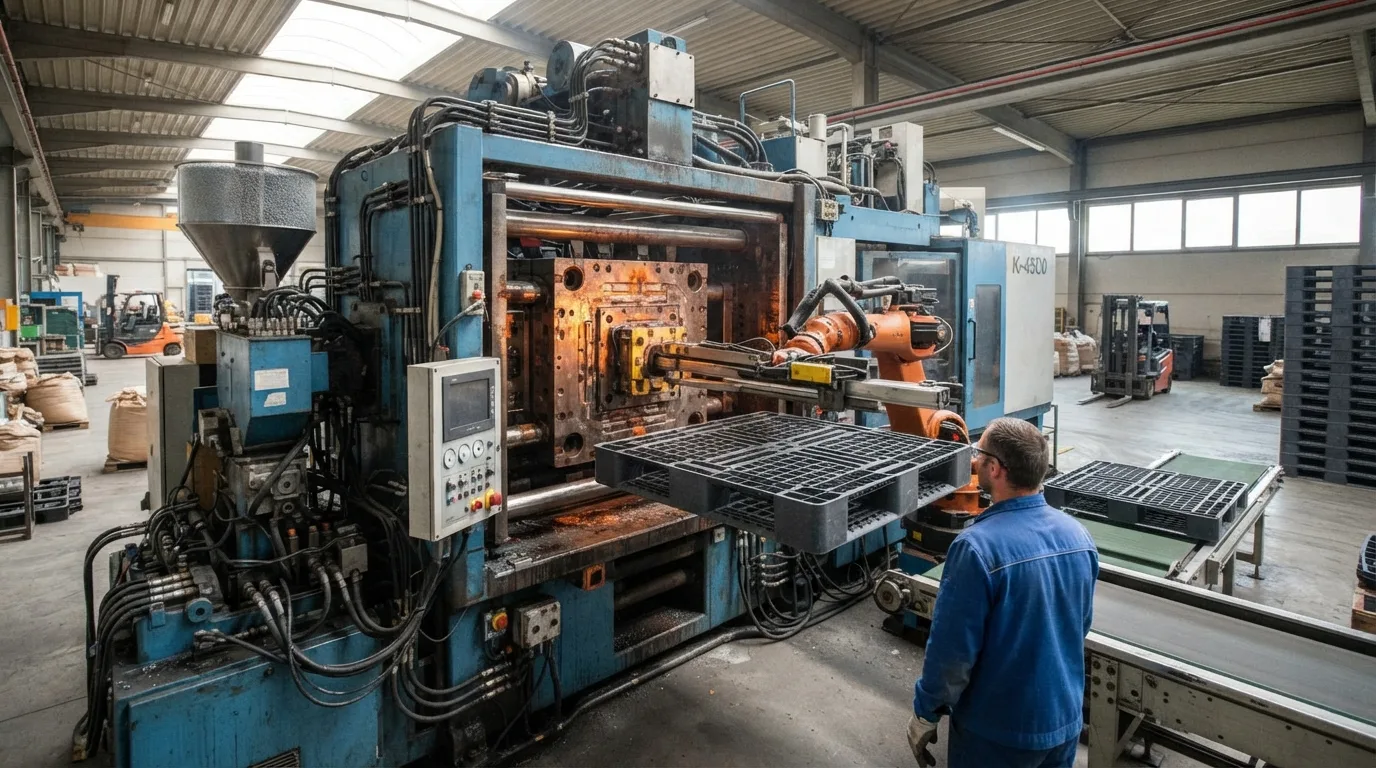 Heavy industrial injection moulding machine producing reinforced transport pallets
What Dictates Sourcing Valuation and Cost per Kilogram?
The commercial cost per kilogram of reprocessed polyethylene is determined by scrap feedstock sorting tiers, color clarity, melt filtration grade, and virgin polymer contract indices. High-density polyethylene commands higher manufacturing expenditure than simpler commodity polymers because of catalytic ethylene polymerisation complexity and energy-intensive low-pressure slurry or gas-phase reactor processes. In the secondary market, feedstock origin establishes the baseline valuation of the finished lot. Natural unpigmented scrap from collected bottle handles commands higher valuation because it accepts downstream color masterbatches without tint interference. Milky-white and opaque translucent scrap feeds sit below natural grades, followed by segregated drum blue stock, and regranulated black utility compound.
Compounding filtration efficiency directly controls production costs. Removing micro-contaminants requires continuous screen changers fitted with fine micro-mesh packs down to 120 mesh (0.125 mm aperture). Running tight wire mesh packs raises backpressure inside the extruder barrel, requiring higher hydraulic drive energy and frequent screen change cycles. Coarse single-screen filtration (40 to 60 mesh) reduces extruder backpressure and processing expense, but allows minute foreign particles to pass into the final pellets. In blow moulding heads, those uncaptured inclusions trigger parison blowout, while in injection gates, they clog hot runner tips.
Pellet commercial value correlates with regional primary virgin polymer market movements and the inclusion of functional stabilization additives. Compounding ultraviolet light stabilizers into outdoor crate materials, or adding targeted slip and anti-static masterbatches into cap formulations, increases total raw-material formulation expenditure. Factory buyers evaluate these functional additions against the operational losses caused by scrap-rate increases on high-speed lines. Confirm technical specifications and processing requirements directly with your compounding supplier when selecting functional additives.
Technical Misconceptions Factory Buyers Have About Recycled Polyethylene
Extrusion technicians often assume that recycled high density polyethylene granules lose base density during repetitive heat cycles. Thermal processing and mechanical shearing do not alter the baseline density of the polymer chain, which is fixed by the linear polymerisation architecture. Instead, excess heat history triggers chain scission, raising the melt flow index, or promotes crosslinking, lowering melt flow and shifting crystalline growth rates. The density of clean, properly homogenized reprocessed lots remains stable within the typical 0.941 to 0.965 g/cm³ band.
Parison sag and uneven wall thickness during blow moulding stem from erratic die swell rather than resin contamination. When the compressed polymer melt exits the annular die tooling, elastic energy stored in oriented molecular coils relaxes, causing the extruded profile to expand in diameter and wall thickness. Regrind blends containing mixed molecular weight distributions produce unstable die swell, leading to erratic bottle weights and off-center pinch-offs. Machine operators resolve these dimensional shifts by purchasing material lots held within tight lot-to-lot melt flow index tolerances within ±0.15 g/10 min.
Tooling engineers sometimes believe that running recycled stock requires cutting new injection cavity steel or altering shrinkage allowances. Blending recycled pellets with virgin polymer relies on tight melt flow matching rather than altering tool geometry. Plants introduce recycled lots without re-cutting tool steel or extending cooling cycles, provided the reprocessed grade closely matches the virgin base resin in melt flow index and density. When melt flow values align, mould cavity fill rates and part shrinkage remain predictable across conversion runs.
Evaluating technical data sheets for specific blow or injection lines requires matching melt strength, flow rate, and mechanical load parameters to tooling limits. To review detailed mechanical properties for your moulding plant or secure specific batch availability, Request a quote from the technical sales team at Golden Square Plast.